
Polarized Training for Real Life: Making the 80/20 Running Plan Work for You
Jan 29, 2026If you’re getting back into running or trying to train smarter instead of harder, an 80/20 running plan provides a clear, sustainable framework for long-term progress. This approach focuses on keeping most runs truly easy to build aerobic fitness and resilience, while strategically adding a small amount of higher-intensity work—like tempo runs and track workouts—to improve speed and efficiency. Rather than living in the uncomfortable middle ground of “kind of hard” runs, this polarized training method helps runners structure their week with intention, balance recovery and performance, and build fitness that actually sticks.
Understanding Polarized Training for Runners: From Easy Miles to Key Workouts
As I’ve been getting back into running after taking some time off, I’ve been reflecting on how I structure my own training plans and how I coach others to do the same.
In this blog post, I focused on how I recommend returning to running using run-walk intervals, gradually building back to being able to run for 30 minutes or about three miles continuously. The focus here is mostly on running by feel. Keep things relatively easy, breathy but not breathless, and don’t stress over heart rate or pace. The goal is simply to complete the time or distance in a way that feels doable and building up your capacity over time. Once that consistency is there, training becomes more intentional.
Once you can consistently hit that three-mile mark and feel okay afterward, the next step is to start polarizing your training with an 80/20 running plan (aka. purposefully dosing more specific pacing throughout your week).
The Engine and the Chassis: Four Types of Runs
I like to use a car analogy to explain different types of runs. You are training both the engine and the chassis. I generally break runs into four categories:
Easy runs focus on engine efficiency, improving how well your cardiovascular system works.
Tempo runs focus more on muscular endurance. This trains more the fitness of the chassis and its ability to tolerate mileage and sustained effort.
Track workouts target engine size and horsepower. These runs improve cardiovascular power and your ability to produce energy.
Long runs develop endurance and stamina. They’re usually paced closer to easy effort, though sometimes they’re more specifically paced depending on your training goals. Long runs are different from truly easy runs. Even when paced easily, they can feel hard when you are pushing the edge of your endurance.

All of these run types working together improve your running economy. Think of it as your overall gas mileage combined with performance. An improved running economy means you can run faster and/further without it feeling harder.
The 80/20 Running Plan Rule and Avoiding the Gray Zone
In general, I follow the 80/20 rule: about 80% of your mileage is easy, and 20% is hard. “Hard” includes anything above threshold pace (your tempo runs and track-style workouts).
This approach minimizes time spent in the gray zone, which is that middle intensity that’s not easy enough to provide the full benefits of easy running and not hard enough to stimulate the adaptations you get from true high-intensity work. Easy running is not just filler; it has distinct and important physiological benefits.
Why Easy Miles Matter
Easy miles help build your aerobic base and improve cardiovascular and metabolic efficiency in several ways. They improve oxygen transport to your muscles, increase red blood cell production, and increase the size and density of your mitochondria—the powerhouse of the cell.
As a middle school science teacher, I can’t help but laugh at how mitochondria are the one organelle everyone remembers. In training, that knowledge actually matters. We can strategically increase mitochondrial density in our muscle cells, improving energy production and efficiency, which directly benefits running economy… IF we keep easy truly easy!
Easy miles also preserve your body so you can get the most out of harder, key workouts within an 80/20 running plan.
Easy Running, RPE, and Zone Two
For most runners, I recommend starting with easy running based on feel. Aim for an RPE (rate of perceived exertion) of about 2–3 out of 10. You should be able to speak in full sentences and feel like you could sustain that pace for a very long time.
Zone two training can be a more advanced version of easy running. Heart rate can be used, but wrist-based monitors often aren’t accurate enough for this purpose. It’s also important to know your true zone two range, which isn’t always the same as what your watch estimates.
Tempo Runs and Lactate Threshold
Tempo runs are often structured like a “race-pace sandwich.” Over time, you work up to sustaining tempo effort for 20–45 minutes, though beginners may start with shorter intervals of five to ten minutes.
These runs are typically around a 10K pace or slightly slower. Tempo running trains your muscles to sustain effort near maximum for longer periods and helps increase lactate threshold. If you’ve noticed in races that your muscles start to burn before your lungs do, tempo runs can be especially helpful.
Track Workouts and VO₂ Max
Track-style workouts involve short, hard efforts with recovery in between. These hard efforts are usually just a few minutes at a time. These are centered around mile pace, which is close to VO₂ max effort.
These workouts aren’t all-out sprints. They’re purposefully paced to increase VO₂ max, essentially increasing the size of your engine. They also improve speed, turnover, power, and some of the form/technical aspects of running economy. Because the efforts are short, you can focus more on form and powerful movement.
Purposefully Paced Long Runs
In many cases, long runs generally stay easy.. When otherwise purposefully paced, long runs become highly goal-dependent.
Long runs build cardiovascular endurance and help your body adapt to prolonged stress. Adding specific paces trains your body to handle race-pace effort when tired. For example, during 10K training, you might do a longer run at slightly slower than tempo pace. During half or full marathon training, you might run the first two-thirds easy and finish the last few miles at race pace.
These workouts are typically added closer to peak training, once you’re confident in the distance and ready to push performance.
Structuring a Running Week: Starting With Two Runs
Now let's discuss how to structure these run types into a weekly schedule. I’ll start with two runs per week and build up to four.
Two runs per week is what I consider the minimum effective dose. It’s not high-performance training, but it’s enough to maintain a base, enjoy running, and even train for a 5K or possibly a 10K.
Personally, I’m currently bouncing between two and three runs per week due to my schedule. Two runs still allows for some meaningful progress, albeit a bit slower.
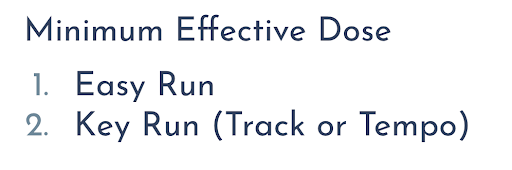
With two runs per week, I recommend:
- One easy run, which can double as your long run. If you’re increasing volume, progress distance very slowly, no more than half a mile to one mile at a time, since each run represents a large portion of your weekly volume.
- One key run, alternating weekly between a tempo run and a track workout.
This is exactly how I program training inside the Women’s Running Academy. Each week includes one key run, alternating between tempo and track workouts to provide variety and balanced adaptation.
For runners preparing for a short race like a 5K, you might emphasize track workouts slightly more while still keeping tempo runs in the mix—for example, two track weeks, one tempo week, then repeating that pattern.
At this point, training for much longer distances on only two runs per week becomes more challenging, which is why this structure is best suited for maintaining fitness or preparing for shorter races.
Expanding the Framework: Three Runs per Week
Once you move beyond two runs per week, we can start to work more intentionally with volume, performance, and overall balance. With three runs per week, I break training into two broad categories: increasing volume or performance, and maintaining volume.
Increasing volume usually aligns with training for a specific event. Maintaining volume is more about keeping your fitness, enjoying running, and continuing to build efficiency through polarized training—without placing big expectations on every run.
Three Runs per Week: Increasing Volume or Performance
If your goal with three runs per week is to build volume or performance, your week might look like this:
One run is your long run, which generally stays in the easy-ish range. That said, as you push volume, it may not always feel easy by the end. The effort can still be appropriate even if it feels challenging due to duration.
The second run is a truly easy run. This is where honesty really matters. Easy means easy. These runs have real physiological benefits, and I personally practice nasal breathing and aim to keep them in zone two. If you’re ready for heart-rate-based training, this can be your designated zone two run each week.
The third run is your key run, alternating weekly between a track workout and a tempo run, just like the structure used in the Women’s Running Academy.
If you’re training for a 5K or shorter, you might lean slightly heavier toward track-style work while still keeping tempo runs in the rotation. If you’re training for a 10K, half marathon, or marathon, you’d flip that balance—more tempo emphasis, but still not eliminating track workouts entirely.
Three Runs per Week: Maintaining Volume
If you’re running three days per week but not trying to push volume, the structure shifts slightly. \
Instead of a formal long run, one run becomes what I call a just-for-fun run. This is an easy-ish run with no expectations—go out and run simply because you enjoy it. The only real guideline is to avoid pushing it too hard so you still have energy for your key workout.
The second run remains a truly easy zone two run, and the third is your key run, alternating weekly between track and tempo. If you’re not training for anything specific, this straightforward track–tempo alternation works well for maintaining fitness and keeping things interesting.
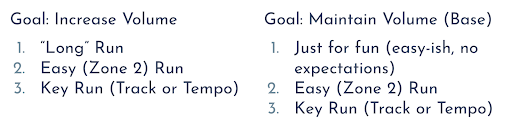
Across both three-run scenarios, you’ll start to see the same themes repeating: easy running, a longer or relaxed run, and a key workout. The exact emphasis depends on where you are in your training and what your goals are.
Moving to Four Runs per Week
The same general principles apply as you increase to four runs per week. At this point, we again consider two scenarios: maintaining volume and improving performance.
Four Runs per Week: Maintaining Volume
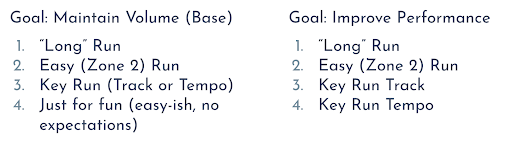
If your goal is to stay solid, maintain fitness, and improve running economy for future goals, your week might include:
One long run, not necessarily one that increases in distance every week, but one that’s longer than your other runs.
One easy zone two run, where you’re very strict about keeping the effort truly easy.
One key run, alternating week by week between a track workout and a tempo run.
One just-for-fun run, which is easy-ish, relaxed, and driven by enjoyment rather than metrics or expectations.
This structure supports consistency, aerobic development, and enjoyment without constant performance pressure.
Four Runs per Week: Improving Performance
If your goal shifts toward improving performance, that’s when we start layering in more intensity. Instead of a just-for-fun run, you build in two key runs per week.
In this case, the week includes:
A long run, usually easy unless you’re purposefully pacing it later in a race-specific training cycle.
A very easy zone two run, kept strictly easy.
A track-style workout, paced around mile pace or VO₂ max effort.
A tempo run, focused on sustained effort near threshold.
Here, you’re hitting all the components of a polarized training plan in a single week. This isn’t necessary all the time, but it makes sense during performance-focused phases of training.
Polarized Training, Simplified
Polarized training, or an 80/20 running plan, can sound fancy, but when you break it down, it’s surprisingly simple. Think of it as a plug-and-play framework. Choose how many days per week you want to run, identify your current goal and season of training, and then hit the essentials: easy running, key workouts like track and tempo, and something that maintains volume or keeps running enjoyable.
That’s your week.
Next On Your Reading List
Don't miss a thing!
Join my newsletter, be the first to know about what's coming up, and get even more great content!
