
A Training Plan for Beginner Runners (or Those Starting Over)
Jan 15, 2026Coming back to running after time off—whether from injury, burnout, or life simply getting busy—can feel overwhelming. A smart training plan for beginner runners isn’t about speed, mileage, or proving anything; it’s about rebuilding strength, confidence, and consistency in a way your body can actually sustain. In this post, I’ll walk you through how I approach starting over with running, using a strength-first foundation, gradual volume progressions, and clear milestones to help you return safely and confidently.
A Year of Highs, And a Hard Stop
Well… it’s been a while since I’ve written anything like this. And after years of consistently putting out weekly emails, podcasts, and posts. I went back and looked at the calendar and honestly couldn’t believe how long it had been.
This time away was a mirror to an even longer break from my running. Starting back again, has me thinking about how I coach athletes who are starting over or even starting from scratch with their running. So, in this post we’ll cover the following pieces of a strong training plan for beginner runners that anyone can use:
- Why strength training needs to come before running when you’re rebuilding
- How I use a graded return-to-running plan with clear milestones
- Why volume comes before pace, heart rate, or “fitness”
- How to use breathing and body feedback to guide progression
- What acceptable soreness looks like (and what’s not)
In my own training, the first half of the year was very performance focused. It was my first time really racing again since having my two youngest children and navigating some health issues along the way. I PR’d in a half marathon in February and then again in May—by nearly ten minutes compared to my times when I was in my 20s. It genuinely felt like a BQ was back within reach, and sooner than I expected.
And then… at the end of July, I busted my knee pretty badly.
I partially dislocated my kneecap, bruised some bones, and thoroughly pissed off a whole collection of tendons and ligaments. The contrast between my running in the first half of the year and the second half is obvious looking at my Garmin mileage graph.
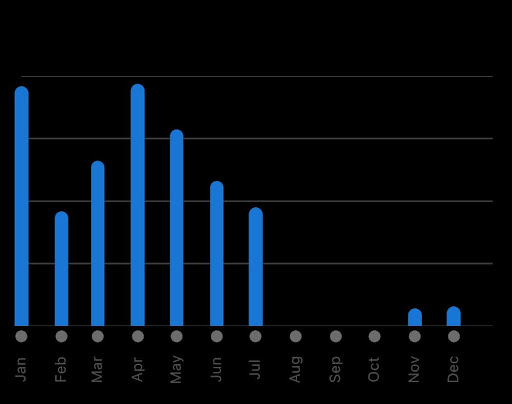
But, I’m finally making my way back—and I’m celebrating the small wins. Recently, I ran three miles straight for the first time after months of run-walk intervals. The knee still talks to me a little afterward, but no more than it did with intervals, and—most importantly—it returns to baseline within a day (we’ll talk about why this is significant below).
I’m honestly surprised by how well I handled the mental side of running at the peak of my performance to not running at all. It almost scared me how little I missed it at first. In some ways, I think it was a relief. A relief from the constant sense of needing to perform—for myself, for my goals, and for my business. I’m entering this new season of running with different goals and a very different training schedule. There’s more presence now, and less pressure.
Going Back to Teaching Changed Everything
Another huge shift in the second half of the year: I went back to teaching middle school science full time.
This probably kept my training on the back burner longer than my knee alone would have. Once I started teaching at the end of September, I went a full eight weeks without doing a single formal workout. No lifting. No gym. Barely even walks. Just… surviving.
Before teaching started, I wasn’t running because of my knee, but I was still strength training within what I call my “trainable menu.” Once school started, even that disappeared for a while.
What became really clear during that time was how much regular, intentional movement had been supporting my body. Without it, I actually hurt more. More aches. More stiffness. Now that I’m back into a rhythm, my body hurts less—not more. I’m lifting two days per week and running three days per week.
Teaching has been A LOT. I honestly love it, and it feels like the right decision, but it definitely took time to find my groove and any semblance of “balance.” Add in coaching my one-on-one athletes, running the Women’s Running Academy, and being a mom to two sports-age boys during football season, and… there wasn’t much room for anything else.
Hence the 15-week break from the podcast/blog, 12 weeks without my weekly email, and nearly 10 weeks without posting on social media.
Stepping Away From the Noise
At first, the break was purely logistical—I didn’t have time. But after a while, it just felt right to keep going.
There were a few weeks where my average daily screen time was around 20 minutes. After years of running an online business and being constantly connected, that felt amazing. When I go to school, my phone goes into my desk drawer in the morning and I don’t look at it again until 3:30 or 4:00. Even though I was more tired overall, I felt more present with my family and friends when I was off. It’s been hard to justify going back.
And yet… I miss some of it. I miss nerding out about running with you all.
I sat down with my assistant recently and mapped out how to bring back the more front-facing parts of this business. You can expect weekly emails again, biweekly podcast episodes, and a few special projects coming in February and May. Social media? Still undecided.
A Training Plan for Beginner Runners Needs to Be Flexible
Steps to Starting From Scratch: Laying the Foundation
With all that context set, let’s talk about what I’ve actually been doing to build back—and what I recommend when building a strategic training plan for beginner runners or anyone returning after time off.
First and foremost, especially as a woman in her 40s: strength training comes first. Running requires strength, and when we zoom out and look at longevity and health, strength training needs to be the foundation. The place I recommend women start is with the 8-Week Fundamentals program that is part of my Women’s Running Academy membership. It is an intentionally progressed program that will help you practice solid technique and mechanics of efficient movement so that you can build up to the “heavy lifting” that everyone is talking about now, but in a way that feels good in your body while supporting your running performance.
From there you’ll learn how to integrate that with any running goal (current or future) and choose the built in strength training options best for you based on your goals/season. You’ll be able to continue to build strength in your running off seasons and strategically maintain that strength as you build your running volume and enter your racing seasons. Instead of hitting it hard in some seasons, falling off when run volume increases, then needing it again when injuries pop up, this way you can make more continuous forward progress.
The next step is a good pair of running shoes. There is no single “best” shoe. Shoes are personal. Anatomy, preferences, movement history—it all matters. I do have guidelines for choosing the right running shoe for you here, but this is not a one-size-fits-all decision.
Steps to Starting From Scratch: Slow, Intentional Volume Building
From there, I use what I call a graded return-to-running plan.
This starts with time-based run-walk intervals and later moves to distance-based progressions. It may look similar to a Couch to 5K plan, but the difference is intention and flexibility. Progression is guided by milestones and by how your body responds—not by arbitrary timelines.
Volume comes first. Pace and heart rate come later.
Until you can run about 30 minutes or three miles straight, I don’t want you worrying about pace or heart rate. Run by feel. Breathing is a vital sign. During this phase, you want to be breathy, but not breathless. It’s ok if you are breathing heavier, but it’s important to still be able to talk in full phrases without gasping. That effort level builds the aerobic base we want without digging a recovery hole.
Running on non-consecutive days is also key at first. Sometimes discomfort shows up during the run. Sometimes it shows up 24–48 hours later. Both matter. For most of the women I work with, that includes monitoring for things like incontinence, urgency, pelvic floor heaviness, pain with intercourse, constipation, in addition to pain beyond normal muscle soreness.
Check your ego here. A little soreness (or even mild pain in the 2–3 out of 10 range) is okay if it resolves within 24–48 hours and doesn’t worsen with the next session. The body needs stress to adapt. You should expect your body to “talk to you” when you apply that stress. What we don’t want is escalating pain, stress that builds up over multiple sessions, and/or failure to return to baseline. That’s exactly how I’ve approached my knee. Some soreness after a run is expected. As long as it settles and doesn’t compound, we’re in a good place.
The Graded Running Milestones of a Training Plan for Beginner Runners
Here’s how I structure a graded return.
Milestone 1 - 1 minute run : 1 minute walk, x 8 (start with 4 or 5 and work your way up)
Milestone 2 - 2 minute run : 1 minute walk x 6 (start with 3 or 4 and work your way up)
Milestone 3 - 3 minute run : 1 minute walk x 5 (start with 2 or 3 and work your way up)
At that point, we start shifting focus from intervals to total distance.
You keep the three-minute run, one-minute walk structure and work toward:
Milestone 4 - 3 minute run : 1 minute walk for 2 total miles.
Milestone 5 - 3 minute run : 1 minute walk for 3 total miles.
Next, we begin increasing continuous running:
Milestone 6 - 1 mile run, walk 2-3 minutes, run 1 more mile
Milestone 7 - 2 mile run, walk 2-3 minutes, run 1 more miles
Milestone 8 – 3 mile run
*This can take weeks or months. Everyone is different. The milestones give you built-in checkpoints to assess how your body is handling the load.*
How to Progress for YOUR Body
I recommend starting with four or five intervals of 1 minute run : 1 minute walk. If your body responds well, add one or two more next time. Gradually build to eight.
When you move to 2-minute intervals, keep total running time consistent at first. Eight minutes total equals four intervals. Build from there. Continue through the first 3 milestones like this, changing one variable at a time. Then you are slowly adding more intervals up to 3 total miles. Finally, you start moving towards longer consecutive bouts of running.
You’re stacking confidence, not just fitness.
Adding Intention Once Volume is Solid
Once you can run about three miles continuously, we can start giving different runs different jobs or polarizing your training.
There are many ways to polarize training once that base is built, and what makes sense depends on your goals. I’ll dig into that in more detail in the next blog/podcast..
For now, the biggest takeaway is this: if you’re returning to running (or thinking about starting from scratch) begin with strength. Build gradually. Pay attention to your body. And give yourself permission to move slowly. I don’t always follow the slow and steady wins the race advice, but it definitely makes sense at this stage. Lay the foundation now so you can confidently go full send later!
Next on Your Reading List
- Maslow for Runners: Base Training for Running’s Essential Needs
- Beyond RICE for Injury: The Recovery Blueprint That Beats It
- Why Is My Upper Back Sore After Running? Posture and Breathing Tips to Help
Don't miss a thing!
Join my newsletter, be the first to know about what's coming up, and get even more great content!
