

How to Strengthen the Pelvic Floor for Running (Or Why We Need to Talk About It)
Feb 26, 2026Most advice on how to strengthen the pelvic floor stops at a single, oversimplified instruction: do more Kegels. But for runners, that narrow view misses what the pelvic floor actually does—and why it matters. This article breaks the silence around pelvic health and reframes the pelvic floor as a dynamic, responsive part of the movement system, showing why understanding function, coordination, and adaptability is just as important as strength.
As you may know, I keep an Aquanotes waterproof notepad in my shower. Its slogan is “no good ideas down the drain,” and that’s exactly why I use it. You may know this because I’ve shared this before (not because I think you are creeping on me in the shower). It’s one of my “must have” things. Some of my best ideas show up in the shower!
Recently, I wrote down this question:
How many pelvic floor issues could be more easily solved if we removed the taboo and simply taught women [and young people in general] how to accurately and safely talk about their bodies from an early age?
Because what I see over and over again is this: pelvic health is treated like a mysterious, slightly shameful topic. People are ashamed and afraid to talk about it, to name the anatomy and to admit when symptoms are present, out loud. All of it carries a cost.
This obviously fits into a much bigger conversation about centering and listening to women! I could go down so many tangents here - the men’s hockey team’s ignorant laughter, the fact that we need a dead man’s files because we can’t just believe women in the first place, the continued reduction of our body autonomy being written into laws, the long delay in recognizing postpartum depression as a serious medical condition, the idea that we had that was dismissed and then passed off by a man as his own receiving praise at work …phew, the rage is swelling. Take a breath…
Let’s regroup and look at our locus of control around this particular issue - the pelvic floor taboo.
Pelvic Health Is Framed Around Problems
For most women, pelvic health only enters the conversation when something is wrong. Leaking. Pain. Prolapse. Heaviness. Instability.
We wait until we’re frustrated, embarrassed, or at our breaking point before learning how to strengthen the pelvic floor.
What we almost never do is learn about the pelvic floor before symptoms appear. We don’t grow up understanding what it does. We don’t talk about its role in the movement. We speak the words for our anatomy in hushed tones. We certainly don’t talk about how a responsive pelvic floor contributes to efficient force generation - our power!
A strong, adaptable pelvic floor is highly correlated with being an efficient mover (someone who can generate and transfer force effectively into the ground while running or jumping). The pelvic floor is central to performance. It’s literally part of your core!
But culturally, pelvic health gets reduced to one word: Kegels.
So many women know the word “Kegel.” Very few understand what the pelvic floor actually does.
The Taboo Starts Early
I’ve seen this firsthand in the classroom.
During a human body unit, when we covered the digestive and excretory systems, my students physically cringed at words like “urine,” “butthole,” or “poop.” “That’s so gross,” “Eww, cringe,” “I don’t want to talk about this.” It all comes at a cost. There’s a somewhat understandable desire to avoid “potty talk,” especially with younger kids. However, in our attempt to be “polite”, we may have swung too far.
When even accurate anatomical language becomes uncomfortable, it creates a gap. And that gap doesn’t stay neutral. It is filled with silence, shame, and avoidance.
When a colleague confided that she might need help with “certain issues,” she couldn’t even say the words. I told her directly: it’s okay to say you pee your pants. That’s something we can talk about (I talk about it all the time on the internet to thousands of people!).
But many women don’t feel like they can.
That is a huge part of the problem!
Symptoms Are Signals, Not Proof You’re Broken
When we can talk openly about our bodies, symptoms feel less isolating and more solvable.
Pelvic floor symptoms are common. They are not something you have to live with indefinitely. But they also aren’t moral failings or signs that your body is defective.
When pelvic health is no longer taboo, we can recognize leaking, heaviness, pain, or instability as signals. When we can say the words outloud, the same way we would say “my knee hurts” or “my foot hurts.” No shame, just information.
Imagine if:
- Kids learned accurate anatomy without embarrassment.
- Teens understood pressure management and breathing.
- Adults knew when to rest, when to load, and when to seek help.
That’s prevention through literacy not fear. AND it’s even deeper than that. It comes with a real understanding of the anatomy.
The Pelvic Floor Is Not Just a “Reproductive” or “Urinary” Structure
We need to normalize language around the pelvic floor. We need to talk about it as a vital part of the movement system, not just something attached to reproduction or urination.
The pelvic floor is not a muscle you clench indefinitely. It’s a dynamic, responsive system.
It works in coordination with your diaphragm and abdominal wall to manage pressure inside the body. It responds to load. It adapts to force. It moves with your hips and your feet. It participates in posture and breathing.
Every step you take while running involves the pelvic floor. A healthy pelvic floor yields, loads, and rebounds with each stride, increasing the importance of knowing how to strengthen the pelvic floor to improve your running efficiency.
Continence matters. Symptom management matters. But those are not its only functions and, in many contexts, not even its primary role. When we ignore the pelvic floor as part of our training, we’re not just risking symptoms. We’re missing out on its contribution to movement efficiency, force transfer, and joint health.
Why “Just Do Your Kegels” Falls Short
If the only instruction women receive is “do your Kegels,” without context, we create another problem.
Most women don’t truly understand what a Kegel is, when it’s helpful, or how it fits into dynamic movement. Without that understanding, some end up training the pelvic floor to be less responsive rather than more adaptable.
Strength is not constant clenching. The pelvic floor must be able to contract, yes—but also to relax, lengthen, and respond. That responsiveness is what makes it useful during force production movements like running and lifting.
The Pelvic Floor During Running: A Functional Perspective
Let’s zoom out and look at running mechanics.
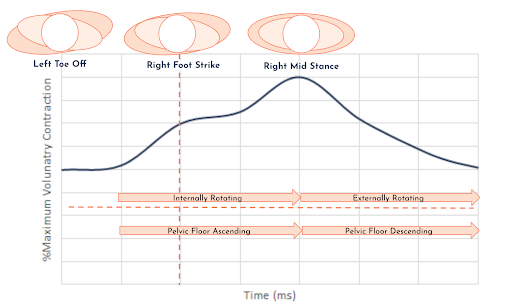
During mid-stance (the moment in your stride when your body is putting the most force into the ground and receiving the most force back) your internal organs shift with the impact. Think of your abdominal contents like a bag of water. They move with you.
As you load into mid-stance, those internal contents shift downward. The pelvic floor lengthens like a trampoline under load.
Then, as you move out of mid-stance, it recoils and rebounds, contributing to forward propulsion.
That rebound works in coordination with your glutes, deep core, and feet. It helps manage impact and supports energy return.
This is not a minor detail. Learning to train the pelvic floor as part of your whole movement system (before symptoms ever arise) offers far more than just prevention. It can enhance performance and efficiency.
And if symptoms do arise later, perhaps after pregnancy or other life transitions, you have the language and understanding to interpret them as information, not failure.
From My Personal Experience to My Personal Mission
I did not grow up understanding any of this.
When I first started leaking during runs, I told no one. Not a single person. I ran like that for years. It wasn’t until I saw other women talking about it that I realized it wasn’t just me.. Hate on social media all you want, it has its benefits (though I am enjoying my little social media break). T
That led me to seek strategies. To learn (and I took a deep dive). To connect the pelvic floor to running mechanics.
Now, I teach pelvic floor education in the context of runners. I often start with symptom management, because that’s what brings people in. My goal is to broaden that framing.
Reframing Pelvic Floor Education
My Pelvic Floor Fundamentals for Runners course has typically been presented through the lens of symptom resolution. And that’s important.
But in the upcoming relaunch, I want to emphasize something bigger: ownership, understanding, and literacy.
On March 22nd, I’ll be hosting a free webinar, The Pelvic Floor Audit for Runners, that shifts the focus toward assessment and awareness. This won’t be a checklist of exercises to “fix” you. It will be about empowering you to understand your body.
We’ll explore:
- How to notice your breath and pressure patterns
- How your body responds under load at your core, hips and even down to your feet
- The relationship between strength and the ability to relax and adapt
- How the pelvic floor is central to your ability to generate power in your stride
We’ll learn how to strengthen the pelvic floor by naming the anatomy and talking openly about our bodies. The pelvic floor is not just a problem to hide. A resilient, responsive pelvic floor is foundational to how we move through the world.
If you’re someone who struggles with pelvic floor symptoms, I would love for you to join.
If you have a pelvic floor (which means all of us) you have something to gain from understanding it. You should join too!
This isn’t just for runners leaking on long runs. It isn’t just for postpartum moms. It isn’t just for people actively experiencing symptoms. It’s for anyone who moves, breathes, lifts, runs, jumps, or lives in a human body.
The more we build shared language and awareness around pelvic health, the less isolating symptoms become. The less shame we attach to normal bodily functions. The more empowered we are to respond early, adapt training appropriately, and seek help without embarrassment.
When more people talk about the pelvic floor as part of the movement system, not just the reproductive or urinary system, we shift the baseline. We normalize anatomy. We create literacy instead of fear. We move from silence to skill. More importantly we can continue to center women in athletics and performance!
Next on Your Reading List
Is Running Bad for the Pelvic Floor? Discover How Strength and Yielding Exercises Can Help
Ribs, Feet and Pelvic Floor: How to Understand Running Mechanics and Boost your Performance
How to Run in Zone 2 Without Feeling Like You are Banging Your Head Against a Wall
Don't miss a thing!
Join my newsletter, be the first to know about what's coming up, and get even more great content!
